Velo
An AI-powered content management platform that automates the entire blog content lifecycle
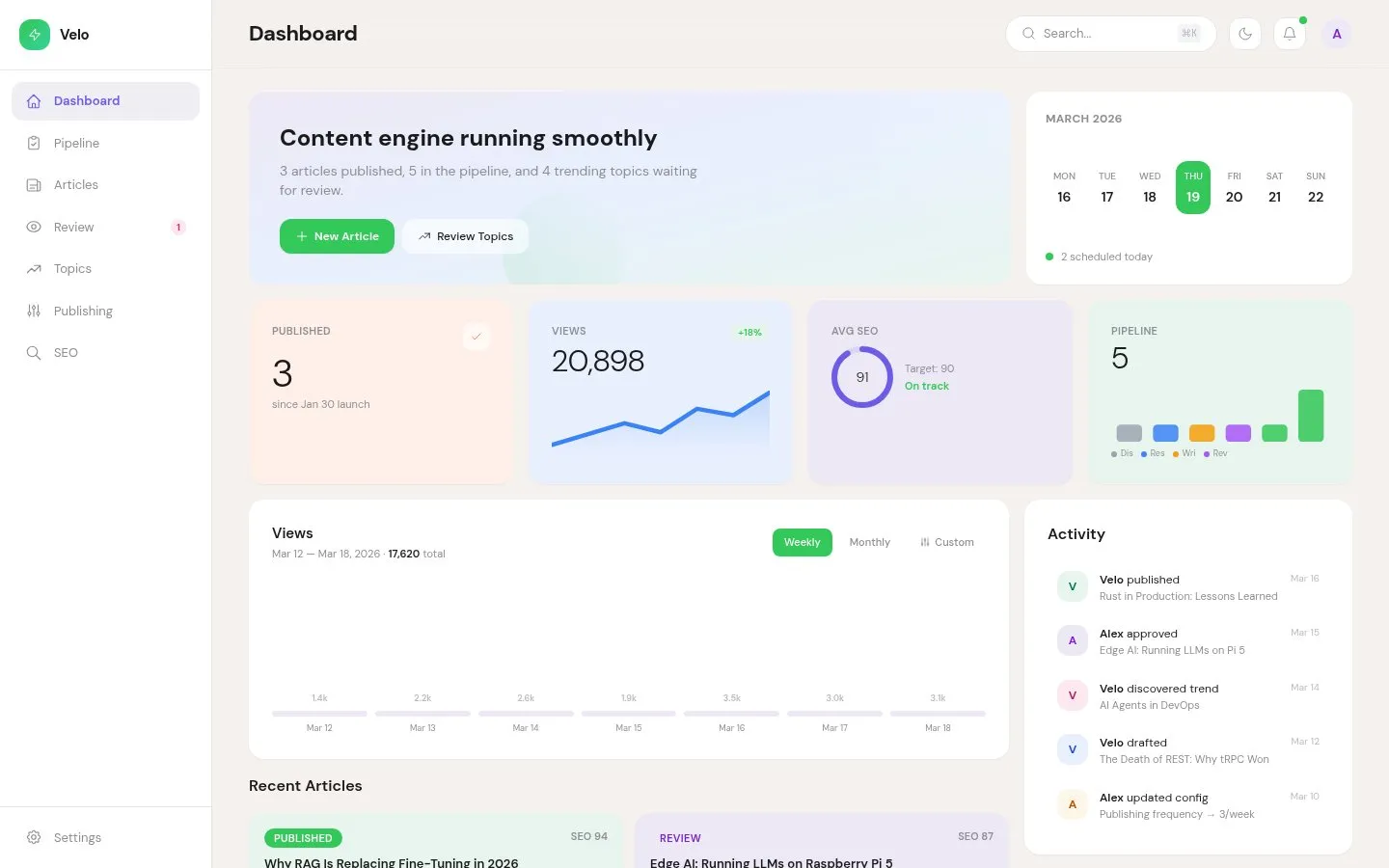
Click on the preview to open full live preview
The Problem
A growing SaaS company was publishing 2–3 blog articles per month, entirely dependent on a single content manager and freelance writers. The process from topic ideation to published article took 3–4 weeks on average, involving manual trend research, multiple drafts, SEO audits with separate tools, and copy-pasting content into four different publishing channels (website, Substack, LinkedIn, X). The team knew consistent content was critical for organic growth, but they couldn’t scale output without proportionally scaling headcount.
Pain Points
Topic selection was gut-driven rather than data-informed — the content manager spent hours scrolling Hacker News, Reddit, and X to find relevant trends, with no systematic way to score or prioritize them. Each article went through 3–5 revision rounds between the writer and editor, with feedback exchanged via email and Google Docs comments, creating version confusion. SEO optimization was an afterthought: articles were written first, then retrofitted with keywords, often requiring structural rewrites. Publishing to four channels meant reformatting the same content four times — adjusting for character limits, platform-specific formatting, and scheduling across different dashboards. Stale content was never refreshed; articles older than 6 months were effectively abandoned despite still ranking for relevant keywords.
Our Approach
We built Velo, an AI-agent-driven content management platform that orchestrates the entire content pipeline from trend discovery to multi-channel publishing. The system uses a OpenClaw-powered agent pipeline with five stages: a Trend Discovery agent that monitors X, Hacker News, Reddit, and tech publications to surface and score trending topics; a Research agent that gathers supporting data, statistics, and source material; a Writer agent powered by Claude that produces long-form articles following configurable style guides; a Review Gate where human editors can approve, request revisions, or reject with feedback that the AI incorporates; and a Publisher agent that formats and distributes approved content across all channels simultaneously. The dashboard — built with React and Tailwind — gives the team a Kanban view of the entire pipeline, an article manager with SEO scoring, a review queue with inline editing, and an SEO performance dashboard tracking keyword rankings and content health. Publishing configuration allows fine-grained control over frequency, writing tone, word count targets, and per-channel scheduling.
Outcomes
The team went from publishing 2–3 articles per month to 10–14 per week — without hiring a single additional person. What used to take 3–4 weeks from topic to publish now takes 2–3 days. The content manager, who previously spent Monday mornings scrolling social media for topic ideas, now reviews a pre-scored list of trending topics and picks the top three in under 15 minutes. The auto-refresh feature flagged 23 stale articles in its first month, recovering search rankings that had been quietly declining. Organic traffic saw a noticeable lift within the first week. The CEO’s summary: ‘We went from a content bottleneck to a content engine overnight.’